Google Ads management · US & Canada

Healthcare Google Ads That Bring Your Practice New Patients

When someone nearby searches Google for the care you offer, your practice can appear at the top of the results. We set up and run those ads for clinics in the United States and Canada, and we show you how many calls and bookings they bring in. Whether you've never tried Google Ads or tried it and weren't impressed, we'll start with an honest look at whether it makes sense for you.

You'll speak with Salman Mehmood, our founder. If Google Ads isn't a good fit for your practice, he'll tell you.

A patient searches

Your ad appears

Sponsored · yourclinic.com/physiotherapy

Physiotherapy Near You | Book an Assessment

Sports injuries, back and neck pain, post-surgery rehab. New patients welcome.

We count what happens next

Phone call, 3 minutes Likely new patient
Online booking request Inquiry
Phone call, 14 seconds Not counted

Illustrative example

How Google Ads works for a clinic

It's simpler than it sounds. Most of the skill lies in making every step lead to a real patient.

Step 1

Someone searches

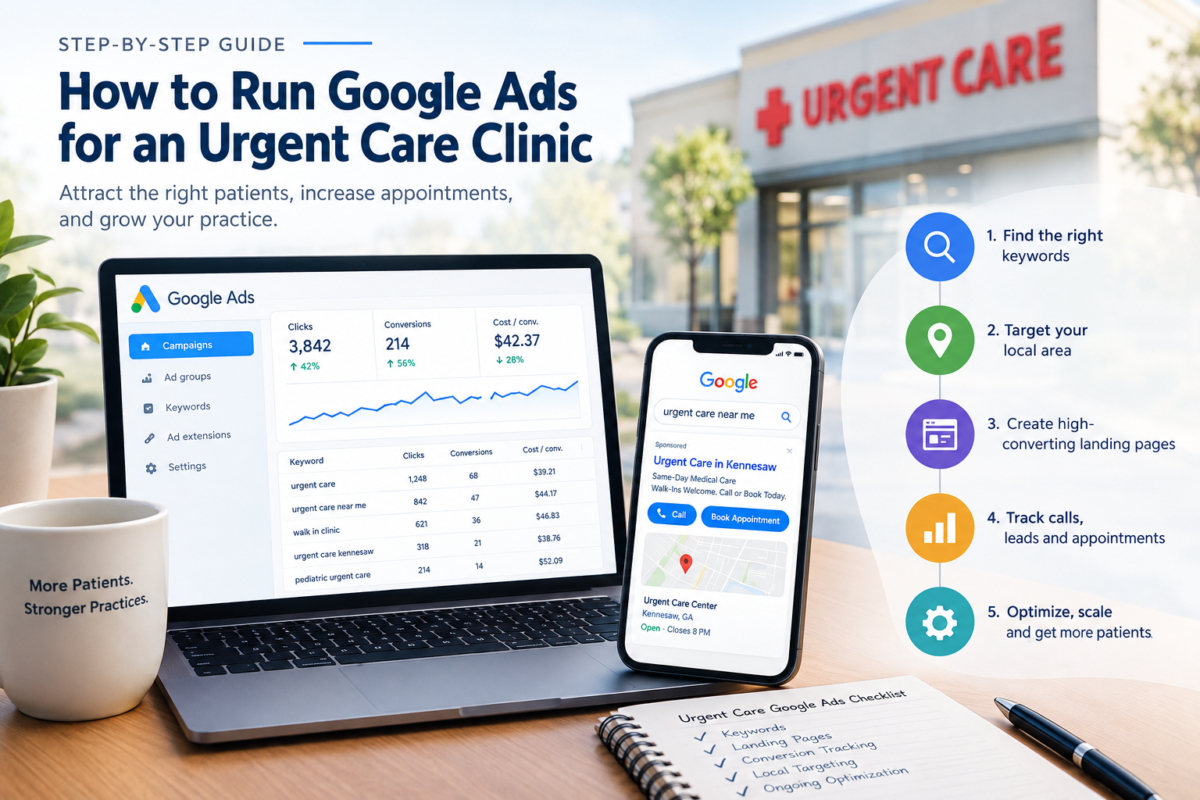
A person near your clinic types something like “urgent care near me” or “psychiatrist accepting new patients”.

Step 2

Your ad shows up

Your practice appears at the top of Google, marked “Sponsored”, with a short message about the care you offer.

Step 3

You pay when they click

Showing the ad is free. You pay a small amount each time someone clicks it, up to a monthly limit you set.

Step 4

They call or book

The click takes them to a page about that service. If it answers their question, they call or ask for an appointment.

When Google Ads disappoints a practice, one of these steps is usually broken. The ad shows for the wrong searches, the click lands on a page that doesn't help, or nobody counts which calls came from the ads. Fixing those steps is what we do.

What we do

How we run Google Ads for healthcare practices

Four parts, roughly in this order over the first three months. You don't need to understand the technical side, but it's here if you want it.

Month 1

We look before we spend

We find out which services you want more patients for, where your patients come from, and how many people search for that care nearby. If you've run ads before, we look at where the money went.

Account audit, keyword and search-volume research by service and location, competitor review, and an agreed starting budget and priority list.

Month 1

We show your ads to the right people

Your ads appear for people ready to book, like “physio near me”. They don't appear for job seekers, students, or people far outside your area. Each ad leads to a page about that specific service, with your phone number easy to tap.

Search campaigns structured by service and location, high-intent keywords, negative keyword lists, location and ad-schedule settings, and dedicated landing pages built or improved for advertised services.

Month 1–2

We count the calls and bookings

Every call, form and booking request that comes from an ad gets recorded. A real conversation counts; a ten-second call asking for your fax number doesn't. Your front desk tells us which ones became patients.

Conversion tracking for calls from ads, website calls with minimum call duration, form submissions and appointment requests as separate actions, plus a regular lead-quality check with your team.

Month 2–3 and onward

We move money to what works

Each week we cut what isn't bringing patients and put more behind what is. Ads can't be set up once and left alone. Competitors change and Google will happily spend your budget on anything you allow.

Search-terms review, keyword and ad refinement, landing-page testing, budget shifts between services and locations, and Performance Max added only once there's reliable conversion data.

We've done this for behavioral health and psychiatry groups, urgent care, physiotherapy and sports medicine, and medspas. Results depend on your specialty, location, competition, budget, and how quickly your team responds to inquiries, so we won't promise a set number of patients.

Client success

What this looked like for real clinics

These numbers come from specific campaign periods. Read them as examples, not as what every practice should expect.

Read the full case studies
Cost per lead: what you spent on ads for each call or booking request.
Cost per new patient: what you spent on ads for each person who actually became a patient.

Behavioral health · Massachusetts

Boston Neurobehavioral Associates

$75 → $25

They paid about $75 per patient referral from directory sites. Through Google Ads, a lead cost as little as $25.

A group with 10+ locations that wanted to rely less on paid referral sites like Psychology Today. We ran ads for their psychiatry and therapy services, leading to one clear page per service.


Urgent care · Kennesaw, Georgia

Dynamic Urgent Care

Just under $10

Cost per lead, with a steady flow of calls and appointment requests

One clinic up against large hospital systems with far bigger budgets. We focused on people searching for urgent care nearby and built a page designed to get them to call or book.

Sports medicine · Toronto

Leaside Sports Medicine

CA$15

Cost per lead, at its lowest

~CA$55

Cost per new patient

They were already running Google Ads but couldn't tell what it was doing. We rebuilt the ads around physiotherapy and orthotics and started counting bookings and forms as well as calls.

Medspa · Combined marketing

Skinfinity Aesthetics Medspa: about 5 to 20+ new patients a month

Over about 1.5 years, from a new website, treatment pages, local search work and Google Ads together. We don't credit it to the ads alone.

Questions practices ask us

It depends on whether enough people near you search for the care you offer, and whether a new patient is worth more than it costs to win one. Most outpatient specialties have that demand. A few services, such as addiction treatment or prescription medicines, have extra Google rules, so we check what you're allowed to advertise first. On the discovery call we'll look at your area with you and say so if the numbers don't look promising.

There are two parts: what you pay Google for clicks, and our management fee. Some of our clients started with about US$1,000–1,500 a month paid to Google, which is enough for one location and a couple of services. Busier cities and competitive specialties usually need more. You set the limit, and Google never charges more than your budget allows.

Once the ads and pages are ready, many practices get their first calls within days. It takes a few weeks to learn which searches bring real patients and what each one costs. We work month-to-month, so you're not locked in while you find out.

Sometimes the market or budget really was the problem, and we'll tell you if we think so. More often the ads showed for the wrong searches, sent everyone to the homepage, or nobody tracked which calls came from them. We'll look through your old account with you and show you what we'd change.

They do different jobs. Google Ads puts you at the top of the results as soon as it's switched on, but stops when you stop paying. Healthcare SEO builds free visibility in the regular results, but takes months. Many practices start with ads to get patients now and add SEO later.

Each location usually gets its own ads, budget and page, because demand and competition differ from one city to the next. You'll see results for each location, so you know which ones need more support. Boston Neurobehavioral Associates, for example, has more than 10 locations. The same approach applies to group practices and healthcare franchises.

Want to read more first? See our guide to running Google Ads for urgent care, ways to market a therapy practice, or how we approach patient acquisition marketing.

Find out if Google Ads makes sense for your practice

A 20-minute call. Tell us which services you want to grow and where. If you've run ads before, bring what you have. You'll leave knowing roughly what it would cost, what to expect, and whether it's worth doing now.

Salman Mehmood, founder of Inbound Attract

Salman Mehmood

Founder, Inbound Attract