Google Partner · Google Ads, SEO & AI search for healthcare practices since 2019 · US & CanadaGoogle Partner · Healthcare search


Healthcare Marketing Guides
Google Ads Cost Per Lead for Clinics: 2026 Benchmarks and What We See in Our Own Accounts
TL;DR: The typical healthcare clinic pays about $66 per lead on Google search ads, but the range runs from under $20 to over $140 depending on your specialty. In our own accounts we've seen about $24 for a mental health group, about CA$23 for a physio clinic and about $52 for an urgent care clinic. Compare your number to your specialty first, then to what each new patient is worth.
"Is $50 a lead good?" is one of the first things clinic owners ask us. Usually they've just seen a Google Ads report, or an agency proposal, and they have no idea whether the cost per lead in front of them is great or terrible.
The honest answer is that it depends on what you treat. A Google Ads cost per lead that would be excellent for a mental health practice could be expensive for a dermatology clinic. One all-industry average doesn't tell you much.
So in this guide we've put the latest healthcare benchmarks next to three accounts we've managed. You'll see what a lead typically costs by specialty, what we've actually paid, why one of our accounts came in above benchmark, and what pushes the number up or down. By the end you should know whether your own cost per lead is a problem or not.
What's a good cost per lead on Google Ads for a clinic?
A good Google Ads cost per lead for a clinic is one at or below the median for your specialty. Across healthcare that median is about $66 per lead, but it ranges from roughly $19 for dermatology to over $140 for mental health. Compare against your specialty, not the overall figure.
That $66 comes from LocaliQ's healthcare search benchmarks, which looked at 3,542 US search campaigns between October 2024 and September 2025. It's very close to the all-industry average of $66.69 in WordStream's 2026 data, so healthcare isn't unusually cheap or expensive overall.
The spread inside healthcare is what matters. Some specialties convert a lot of clicks into leads. Others pay for many clicks before anyone calls.
A "lead" also means different things in different reports. Some count every form and call. Others only count calls over a set length. When you compare your numbers, check what your own account counts as a conversion.
Cost per lead by specialty: the 2026 benchmarks
Here are the healthcare specialties most of our clients fall into. These are LocaliQ's figures, and they're medians, so a few unusually high or low campaigns don't skew them.
Specialty
Median cost per lead
Conversion rate
Dermatology
$18.54 per lead
25.33% convert
Physical therapy
$32.79 per lead
15.35% convert
Emergency medicine
$41.68 per lead
6.89% convert
General practice and family medicine
$62.80 per lead
11.63% convert
All healthcare
$66.02 per lead
8.09% convert
Hospitals and clinics
$72.97 per lead
6.10% convert
General dentistry
$84.77 per lead
7.74% convert
Plastic and cosmetic surgery
$102.51 per lead
8.52% convert
Mental health
$141.17 per lead
1.85% convert
Source: LocaliQ healthcare search advertising benchmarks, US campaigns, October 2024 to September 2025.
WordStream's broader 2026 numbers point the same way. Its physicians and surgeons category averaged $40.04 per lead, well under the all-industry figure.
Two patterns stand out. Physical therapy and dermatology are cheap because so many clicks turn into leads, with conversion rates of 15.35% and 25.33%. Mental health is expensive because very few do, which we'll come back to.
What we've seen in our own accounts
Benchmarks are useful, but you probably want to know what happens in a live account. Here are three we've managed, all with calls, forms and bookings tracked as conversions.
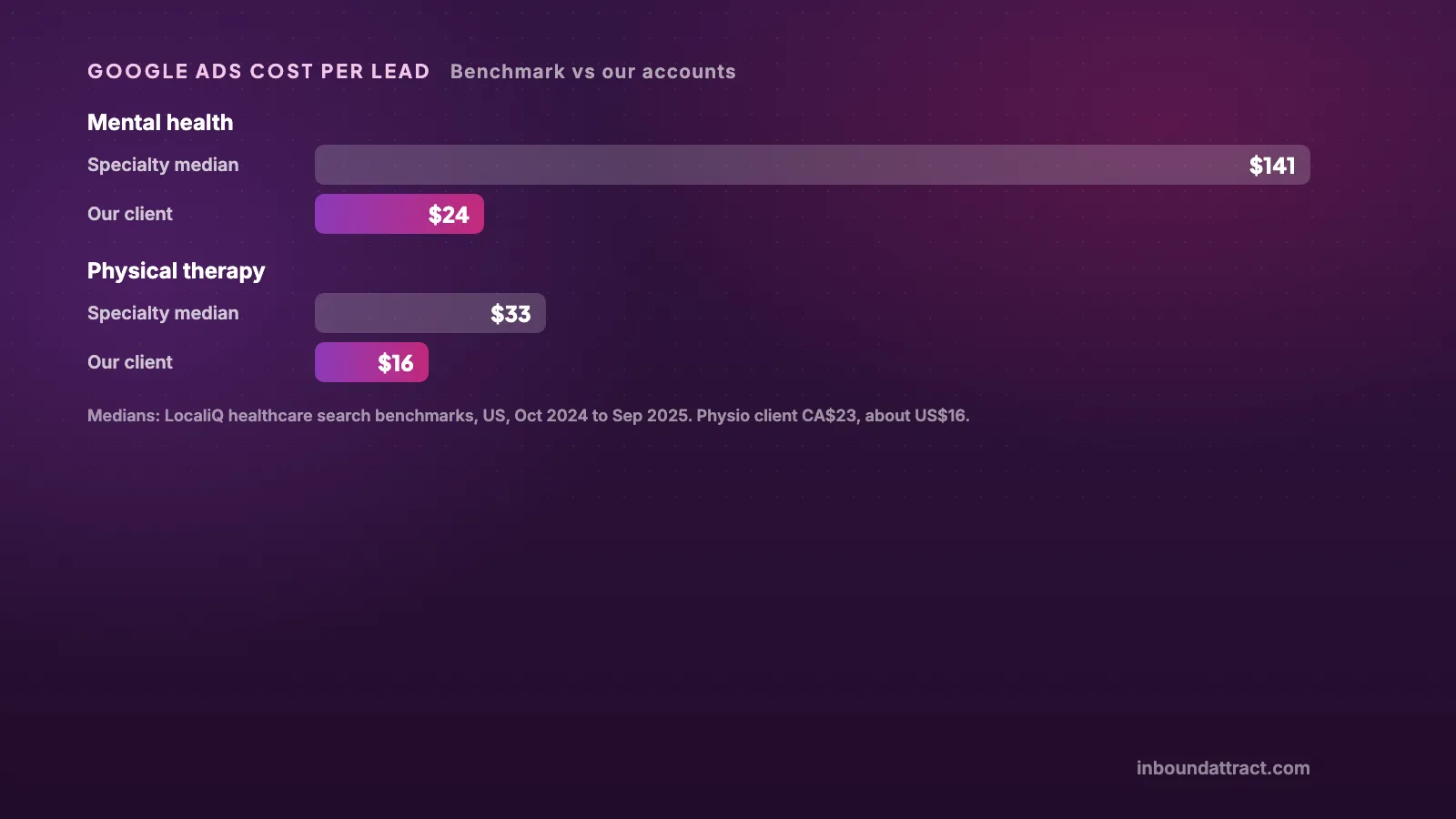
A Massachusetts mental health group running more than 10 locations. They were paying about $75 for each directory referral when we started in October 2024. Over the next two years, Google Ads produced 3,221 leads, averaging roughly $24 apiece, including 1,612 phone calls and 691 enquiry forms. That's around a sixth of the $141 mental health median.
Leaside Sports Medicine in Toronto. Leaside had been running a Smart Campaign, where Google decides most of where your ads show, and only phone calls were being tracked. We rebuilt it into Search campaigns around physiotherapy and orthotics. Between February 2025 and October 2026 the account recorded 1,007 conversions averaging around CA$23, including 276 bookings made online. At the Bank of Canada's 2025 average rate, CA$23 is about US$16, roughly half the physical therapy median. You can read Leaside's full case study for the details.
Dynamic Urgent Care in Kennesaw, Georgia. We ran this account between June and November 2024. What we built stayed live after the handover, and in their first 12 months they produced 180 conversions, roughly $52 apiece. That's above the $41.68 emergency medicine median, and there's a reason for it: Dynamic competes with large hospital systems bidding on the same local searches. The Dynamic Urgent Care case study shows how we built it, and our guide covers how we set up urgent care campaigns.
We're including the account that came in above benchmark on purpose. A higher cost per lead isn't automatically a bad result. For an independent clinic up against hospitals, $52 for someone who wants to walk in today can still be a very good deal.
Why does mental health cost so much per lead?
Mental health has the highest cost per lead in healthcare because so few clicks convert. LocaliQ puts its conversion rate at just 1.85%, against 8.09% for healthcare overall. In our experience, people researching therapy often click, read and leave, and Google limits the follow-up ads other clinics rely on.
That second point matters more than most practices realize. Google treats health as a sensitive category in its personalized advertising policy, so you can't build remarketing lists to follow up with people who visited your site. In other industries, remarketing is a common way to reach people again after they leave without booking.
So how did the mental health group above get to about $24? The core of it was campaigns built around specific services, landing pages written for each one, and call tracking from day one, so the budget kept moving toward the searches that produced calls. If you run a practice in this space, our page on marketing for therapists explains how we approach it.
What pushes a clinic's cost per lead up?
Four things raise cost per lead in almost every clinic account we audit: bidding against hospital systems on the same searches, broad keywords that attract researchers, ads that land on weak pages, and no call tracking. Fixing the last three is usually within your control.
Competing with hospitals. Big systems have big budgets, and they bid on the same local searches you do. You can't outspend them, but you can be more specific. Targeting the people actually in your area with Google's "Presence" location setting, and bidding on the services you're best at, helps you avoid paying for clicks you were never going to win.
Broad keywords. "Physio" or "therapy" brings in students, job seekers and people reading about symptoms. "Physio for a sprained ankle near me" brings in someone who wants an appointment. Keep your keywords close to what a ready-to-book patient types.
Weak landing pages. Sending every ad to your homepage makes people hunt for what they searched for. A page about that one service, with your phone number and booking button near the top, turns more clicks into leads.
No call tracking. In a 2017 survey, about 80% of insured US patients said they used the phone to book. If your account only counts forms, it can't tell which ads make the phone ring. Google lets you count calls from ads and from your website as conversions, and you can set a minimum duration so brief calls aren't counted.
How much should a small clinic spend on Google Ads?
Most single-location clinics we work with spend between $1,000 and $3,000 a month on Google Ads, focused on one or two services. Busier clinics and practices with a few locations usually spend $3,000 to $10,000. Start with the services you most want to fill, not every service you offer.
You can sanity-check a budget with simple math. If your specialty's cost per lead is around $40, a $2,000 monthly budget works out to roughly 50 leads. Divide your budget by your expected cost per lead, then ask whether that many enquiries would make a difference to your schedule.
Smaller budgets don't have to mean a higher cost per lead. What they do mean is less room to test. With $1,000 a month, it's better to run one tightly focused campaign well than to spread it across five services.
Cost per lead isn't the finish line
A cheap lead that never books is worth less than an expensive one that turns into a patient. Cost per lead is where most reports stop, but it's the start of the picture, not the end.
The number that pays your bills is cost per new patient. Weigh it against the value of a patient across a full course of treatment, not a single visit. Our guide on what a new patient really costs walks through how to work that out. Our urgent care guide also has a worked example where a $50 lead beats a $20 one.
This is also why tracking matters. Once calls, forms and bookings are all counted, you can see which campaigns bring in patients and not just enquiries, and move budget to them.
The bottom line
If your Google Ads cost per lead is close to your specialty's median, you're in a normal range. If it's well above, look at your keywords, landing pages and call tracking before you raise the budget. And whatever the number, judge it against cost per new patient.
In our accounts, careful setup brought cost per lead to about a sixth of the mental health median and about half the physical therapy median. Not every account beats benchmark, but every account should know where it stands.
If you'd like a second opinion on your numbers, see how our Google Ads management for clinics works, or book a 20-minute discovery call. Bring your last few reports and we'll show you how your cost per lead compares with your specialty and what we'd change first.
Frequently asked questions
What is the average cost per lead for Google Ads in healthcare?
The median healthcare cost per lead on Google search ads is about $66, based on LocaliQ's analysis of 3,542 US campaigns. It varies a lot by specialty, from about $19 for dermatology to about $141 for mental health.
Is $50 a good cost per lead for a clinic?
It depends on your specialty. For mental health, general dentistry or cosmetic surgery, $50 would be well below the median. For physical therapy or dermatology, it would be above it. Check your specialty's benchmark, then set it against the value of a new patient to your clinic.
Should phone calls count as leads in Google Ads?
Yes, for most clinics they should. Many patients still book by phone, and Google lets you count calls from ads and from your website as conversions. Choose a minimum call duration so accidental or very short calls are left out.
How long does it take to bring cost per lead down?
In our accounts, the first few weeks mostly show you which searches and services produce calls. Most improvement comes over the following months, as you cut the searches that don't convert and move budget to the ones that do. Big swings in the first month are normal while the account collects data.
Does a small Google Ads budget mean a higher cost per lead?
Not by itself. A small budget gives you less room to test, so it works best focused on one or two services. A well-targeted $1,000 campaign can have a lower cost per lead than a scattered $5,000 one.

Founder, Inbound Attract. Helping clinics in the US and Canada get new patients from Google Ads, SEO and AI search since 2019. About Salman · LinkedIn
Request a Consultation
LIMITED APPOINTMENTS AVAILABLE