Google Partner · Google Ads, SEO & AI search for healthcare practices since 2019 · US & CanadaGoogle Partner · Healthcare search


Healthcare Marketing Guides
How Patients Use ChatGPT to Find a Clinic, and How to Get Yours Recommended
TL;DR: More than a third of US patients who chose a doctor in the past year say AI tools like ChatGPT influenced the decision. Those tools build their answers from pages they can read, your Google Business Profile and what reviews say about you. For one of our clients, a single page that answered a common patient question led to tens of thousands of appearances in Google's AI answers. Start with clear answer pages, a complete profile and steady reviews.
A patient with a sore shoulder used to type "physio near me" into Google and scroll. Now a growing number open ChatGPT and ask, "Who's the best physio near me for a rotator cuff injury?" They get a short answer with a few clinic names, and many of them never see a list of links at all.
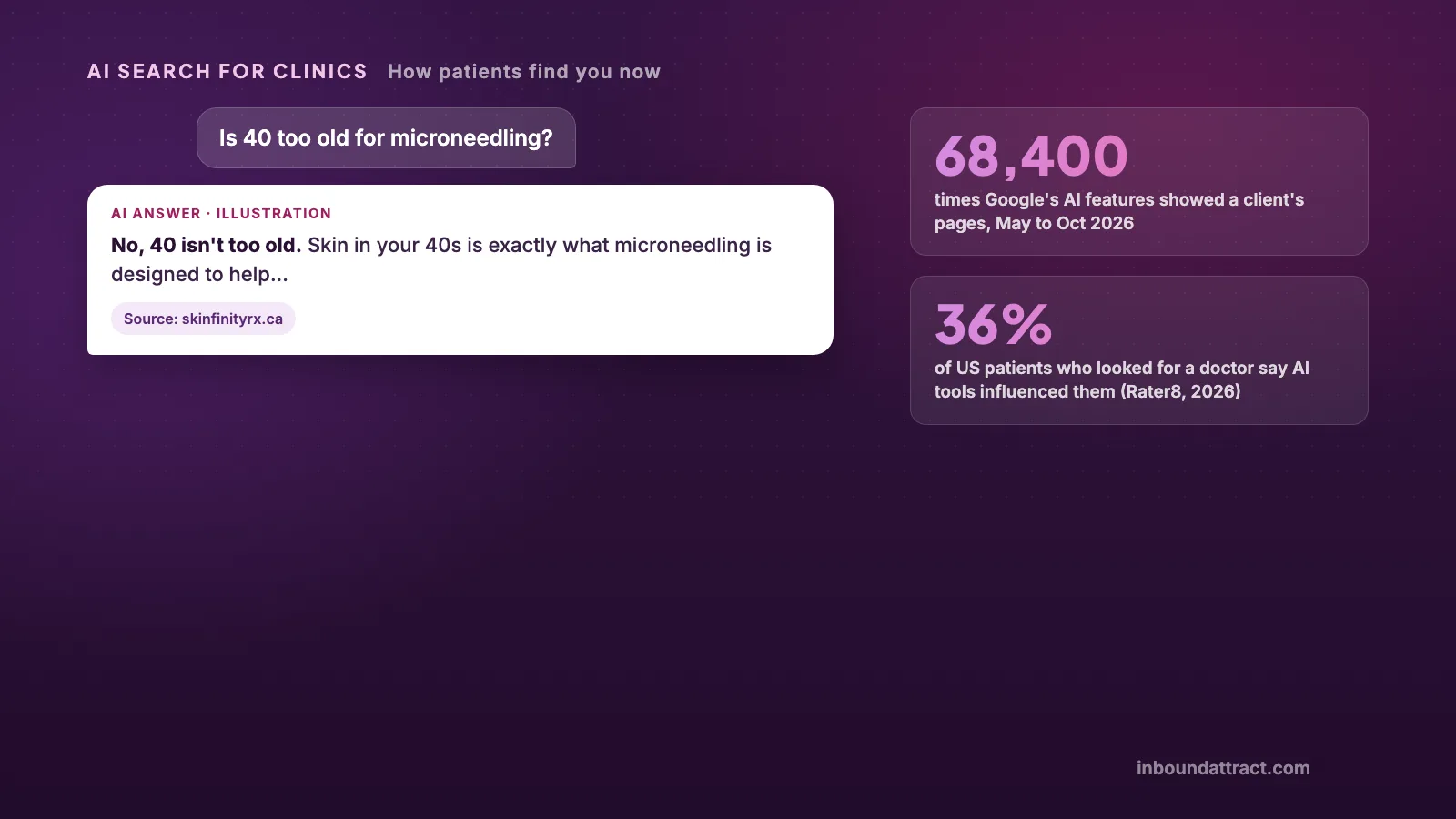
That's a big change for any clinic that depends on new patients. In Rater8's 2026 Patient Choice Report, 36% of patients who looked for a doctor said AI tools influenced their choice, slightly ahead of Google search at 34% and referrals from other doctors at 32%.
So how does ChatGPT decide which clinics to mention, and how do you become one of them? Below we explain where these answers come from, show what happened when one of our clients' pages became the answer, and give you a simple way to check where your clinic stands today.
How do patients use ChatGPT to find a clinic?
Patients use ChatGPT and similar tools to ask about symptoms, compare treatments and get a shortlist of local clinics before they book. Nearly half of US patients now use AI tools to research providers, and many take the answer at face value without checking another source.
The numbers are moving fast. Rater8 found that 47% of patients used AI tools to research providers in 2026, up from 31% the year before. The same survey found that 37% of patients trust Google's AI Overview more than any other part of the results page, against 20% for the regular links.
Trust is the part clinics should pay attention to. According to CXM World's write-up of the report, 60% of patients accepted an AI summary without checking further, even though many had seen wrong information about a provider from an AI tool. If an AI answer describes your clinic badly, or leaves you out, a lot of patients won't dig any deeper.
Where do ChatGPT's clinic recommendations come from?
ChatGPT and Google's AI answers recommend clinics using information they can find and read online: your website, your Google Business Profile, reviews and other sites that mention you. Nobody outside these companies knows the exact formula, but they all rely on pages they're allowed to crawl.
For ChatGPT, that starts with OpenAI's search crawler. OpenAI says sites that block OAI-SearchBot won't appear in ChatGPT's search answers, so the first thing to check is that your website lets it in.
Google is open about its own AI answers. Its guidance on AI features and your website says there are no extra requirements to appear in AI Overviews. A page just needs to be indexed and eligible to show a snippet, and the normal SEO basics apply. Google also mentions keeping your Business Profile up to date.
For local searches, Google ranks clinics on relevance, distance and prominence. Prominence includes how many reviews you have and how many other sites link to you. It's reasonable to expect AI answers built on Google's data to lean on the same signals.
What happened when one of our clients became the answer
Skinfinity Aesthetics runs an aesthetics clinic in Mississauga, Ontario. When their SEO work began in February 2026, one of our early articles tackled a question people often have months before booking anything: Is 40 too old for microneedling?
The page answers in its first sentence. No, 40 isn't too old, and here's why. The rest explains what the treatment does for skin in your 40s, what to expect at an appointment and how recovery works. It's written by the clinic's director, not a faceless content team.
Between the middle of May and the start of October 2026, Search Console recorded roughly 68,400 appearances of Skinfinity's pages in Google's AI features. That one article accounted for close to 50,000 of them. Google was using Skinfinity's answer to respond to people asking the same question.
Regular search grew alongside it. Over the first eight months, Google clicks climbed 152%, from 429 to 1,080, while the site's typical ranking improved from 33.9 to 11.5. Roughly seven in eight of those visitors weren't searching for the clinic's name at all. You can see the full numbers in the Skinfinity case study.
What makes a page easy for AI tools to quote?
AI tools quote pages that answer one clear question near the top, in plain language, from a source that looks trustworthy. Put the direct answer in the first sentence or two, then explain the details. Use headings that match what patients ask, and keep the important content in text.
Here's what that looks like in practice:
1. Give each question its own page. "Is microneedling worth it?" and "How much does microneedling cost in Mississauga?" work better as two pages than as one long services page.
2. Put the answer first. If a patient could stop reading after two sentences and still have their answer, an AI tool can lift those two sentences too.
3. Name the clinician who wrote or reviewed it. It shows patients, and search tools, who stands behind the advice.
4. Keep it in text. Google's guidance says to keep important content in text form, and a price list saved as an image is invisible to most tools.
5. Start with your front desk. The best topics are the questions patients already ask on the phone, and your receptionist knows them better than any keyword tool.
You don't need special code for this. Google says you don't need new machine-readable files or special schema to appear in its AI features, though any structured data you do use should match the visible text on the page. This is the same work as good healthcare SEO and AI search, done with patients' questions in mind.
Your Google profile and reviews still do a lot of the work
When someone asks an AI tool for a clinic near them, local signals matter. Your Google Business Profile tells Google where you are, what you treat and when you're open. Google's own advice is that complete, accurate profiles are more likely to show in local results.
Reviews carry even more weight with patients than most clinic owners expect. In the Rater8 survey, 75% of patients said they wouldn't book a provider rated below 4.0 stars, and 55% had cancelled or avoided a booking because of online reviews.
Skinfinity's profile is a good example of the two working together. Alongside the SEO work, searches that brought up their profile were up 858% for May to September 2026 against that stretch in 2025. If your profile needs attention, our local SEO and Google Business Profile page explains what we fix first.
How can you check whether ChatGPT recommends your clinic?
The simplest test is to ask. Open ChatGPT, Google's AI Mode or Perplexity and type the questions a new patient would ask, using your city and your main services. Note whether your clinic appears, how it's described and which other clinics show up. Repeat it every month.
Try questions like these, swapping in your own city and services:
1. "What's the best [your specialty] clinic in [your city]?"
2. "Where can I get [your main treatment] near [your neighborhood]?"
3. "Is [your clinic name] a good place for [treatment]?"
4. "How much does [treatment] cost in [your city]?"
5. "[A common patient question about your main treatment]"
Answers change from one day to the next, so don't read too much into a single result. What you're looking for is a pattern over a few months. Are you mentioned more often? Are the details about you correct?
If you have Google Search Console, check its reports for AI features too. That's where Skinfinity's 68,400 figure came from, and it shows which of your pages Google is using in its AI answers.
A short checklist to start this month
You don't need to do everything at once. These steps cover most of what AI tools look at, roughly in the order we'd tackle them:
1. Check your robots.txt doesn't block Googlebot or OpenAI's OAI-SearchBot.
2. Fill in every field of your Google Business Profile, including services and opening hours.
3. Give your team an easy routine for asking pleased patients to leave a review.
4. Check that your clinic's name, address and phone details are identical on your site and in every directory.
5. List the ten questions your front desk hears most, and publish one answer page per question.
6. Put a named clinician on each of those pages.
7. Run the five-question test above once a month and keep notes.
If you'd rather see where your money goes on the paid side first, our breakdown of what a lead costs on Google Ads shows the benchmarks by specialty.
The bottom line
AI tools are already part of how patients choose a clinic, and they're catching up with Google search fast. They recommend clinics they can read about, trust and match to a patient's question.
That means the work is familiar. Answer patients' questions clearly on your site, keep your Google profile complete, earn steady reviews and make sure AI crawlers can reach you. Skinfinity's results show what one well-written answer page can do.
If you want to know how your clinic shows up in AI answers today, read about our healthcare SEO and AI search work, or book a 20-minute discovery call. We'll run the test with you and show you which questions you're missing.
Frequently asked questions
Do patients really use ChatGPT to find doctors?
Yes, and the number is growing quickly. In Rater8's 2026 survey of 992 US adults, 36% of patients who looked for a doctor said AI tools influenced their choice, and 47% had used AI tools to research providers, up from 31% the year before.
Do I need special code or an AI file on my website?
No. Google says there are no extra requirements or special files needed to appear in its AI features. The pages need to be indexed and eligible for a snippet. For ChatGPT, make sure your site doesn't block OpenAI's search crawler, OAI-SearchBot.
How long does it take to show up in AI answers?
It depends on your specialty, the clinics around you and the state of your website. For Skinfinity, SEO work started in February 2026, and Search Console was recording AI feature impressions from mid-May, with about 68,400 by early October. Most of the effect builds over several months.
Is getting into AI answers different from SEO?
Mostly it's the same work with a different focus. Pages that rank well and answer one question clearly tend to be the ones AI tools quote. The extra emphasis is on direct answers, named authors, reviews and a fully filled-in Google profile.
Can ChatGPT get my clinic's details wrong?
Yes. Many patients in the Rater8 survey said they'd seen incorrect provider information from an AI tool, yet 60% accepted AI summaries without checking. Keeping your name, address, hours and services the same everywhere online is the best protection.

Founder, Inbound Attract. Helping clinics in the US and Canada get new patients from Google Ads, SEO and AI search since 2019. About Salman · LinkedIn
Request a Consultation
LIMITED APPOINTMENTS AVAILABLE